
Roofing across Carlisle, Cumbria & South West Scotland

07519 261004

Roof Evidence & Repair Guide

Storm and emergency roofing

What to do while a roof is open to the weather, what counts as storm damage, and what evidence supports an insurance discussion.

Answers in this topic

What should I do after storm damage to my roof?

The short answer

Safety first, evidence second, repairs third. Keep people away from fallen material, check from a safe distance whether anything is still loose, and photograph what you can see from the ground before anything is cleared. Then arrange temporary protection if the roof is open, and a proper inspection once conditions allow.

What evidence should you look for?

Slates, tiles or ridge material on the ground, or debris caught in gutters.

What it can mean
Coverings have been displaced and the roof may be open.
What else could explain it
Material can be blown from a neighbouring property, so its presence does not prove it came from your roof.

Urgent · Inspection needed to confirm

What could this mean?

Photographs taken before any clearing are the most valuable record you can create, both for diagnosis and for any insurance discussion.

What this evidence cannot tell you

Never go onto a roof after a storm to assess it. Loosened coverings and wet surfaces make that genuinely dangerous, and the assessment you gain is not worth the risk.

How serious is it? — Urgent

Loose material can fall and an open roof admits water until it is covered.

What this looks like on a real roof

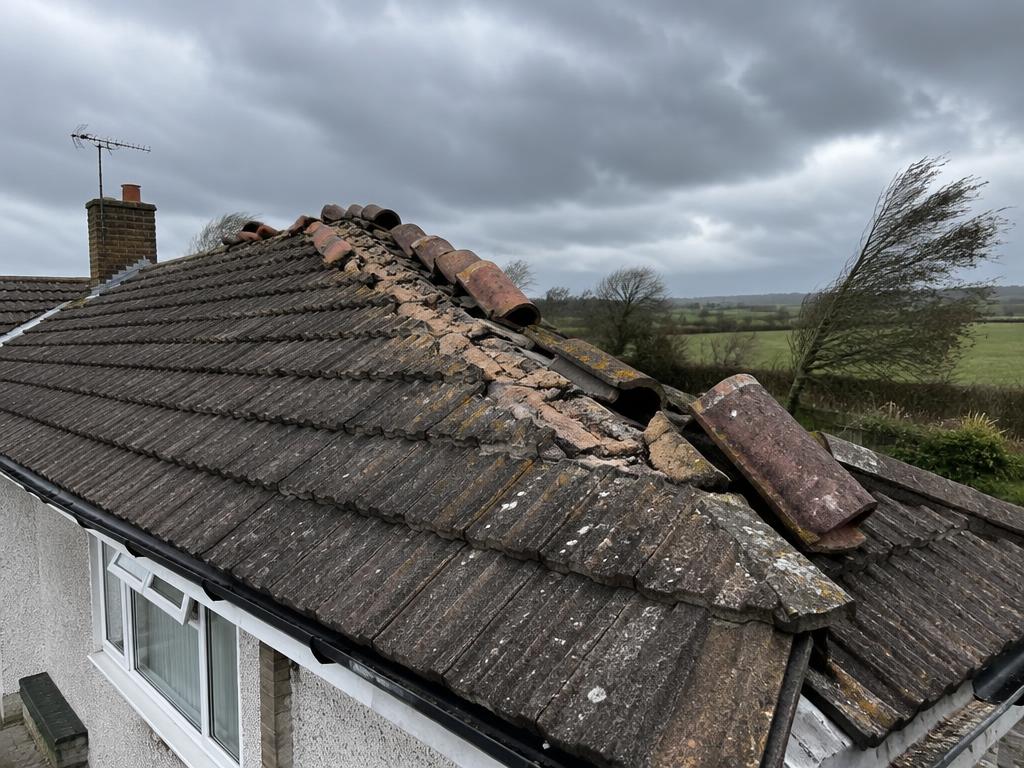
Illustrative example: storm-displaced ridge tiles and broken bedding mortar on an exposed bungalow roof

Illustrative example — not a record of a completed job

Ridge tiles visibly out of line after a named storm, with mortar debris found on the ground.

Property
Exposed rural bungalow with a concrete tile roof
Area
Typical of open, wind-exposed sites across Cumbria and the Borders
Evidence found
Several ridge tiles lifted and displaced, bedding mortar broken away along part of the ridge line, and loose pieces at risk of falling.
How it was inspected
Ground-level observation from a safe distance, with aerial imagery used to record the full length of the ridge without anyone going onto the roof.
Assessment
Loose ridge tiles above an area people can walk through are treated as a safety matter first. Whether the rest of the ridge is secure is a question for inspection, not for the visible damage alone.
Scope of work
Broader repair
Outcome
The usual response is to make the loose sections safe, then re-bed or convert the ridge to a mechanically fixed dry system once the weather allows.

Related services

What should you do next?

Photograph each elevation and the debris on the ground, then arrange attendance. Keep any receipts for emergency measures you take.

Read the full guide on this

How do I know whether my roof suffered hidden storm damage?

The short answer

You often cannot, from the ground. Wind can loosen fixings, lift coverings and crack bedding without removing anything. The practical checks are looking for fresh debris, comparing each elevation against earlier photographs, and checking the loft for new damp. Anything beyond that needs a closer look from above.

What evidence should you look for?

Fresh mortar or slate fragments on the ground after a storm.

What it can mean
Something above has been disturbed even if nothing has come away whole.
What else could explain it
Long-standing weathering sheds material too, so fragments are not proof of storm damage.

Investigate · Inspection needed to confirm

New damp in the loft after the storm, where it was previously dry.

What it can mean
The covering or underlay has been breached.
What else could explain it
Exceptional wind-driven rain can penetrate a sound roof briefly without lasting damage.

Repair soon · Inspection needed to confirm

What could this mean?

This is where aerial imagery earns its keep: it documents the visible condition of ridges, hips and flashings quickly without anyone walking a recently storm-loaded roof.

What this evidence cannot tell you

Imagery records the visible surface only. It cannot confirm the grip of a fixing or the condition of underlay beneath an intact covering.

Related services

What should you do next?

Check the loft after the next heavy rain and compare your elevation photographs against any taken previously.

Read the full guide on this

Can a damaged roof be temporarily made watertight?

The short answer

Usually yes. Sheeting, temporary covers and localised holding repairs can keep weather out until a permanent repair is possible. Temporary work is meant to buy time safely, not to last. It should be recorded and photographed, and the permanent repair should follow a proper inspection rather than being left indefinitely.

What could this mean?

Weather often dictates the sequence. Making a roof safe in a gale and diagnosing it properly later is the right order, not a shortcut.

What this evidence cannot tell you

Temporary covers can themselves be displaced in continuing high winds, so they need checking rather than forgetting.

What this looks like on a real roof

Illustrative example: storm-displaced ridge tiles and broken bedding mortar on an exposed bungalow roof

Illustrative example — not a record of a completed job

Ridge tiles visibly out of line after a named storm, with mortar debris found on the ground.

Property
Exposed rural bungalow with a concrete tile roof
Area
Typical of open, wind-exposed sites across Cumbria and the Borders
Evidence found
Several ridge tiles lifted and displaced, bedding mortar broken away along part of the ridge line, and loose pieces at risk of falling.
How it was inspected
Ground-level observation from a safe distance, with aerial imagery used to record the full length of the ridge without anyone going onto the roof.
Assessment
Loose ridge tiles above an area people can walk through are treated as a safety matter first. Whether the rest of the ridge is secure is a question for inspection, not for the visible damage alone.
Scope of work
Broader repair
Outcome
The usual response is to make the loose sections safe, then re-bed or convert the ridge to a mechanically fixed dry system once the weather allows.

Related services

What should you do next?

Ask for photographs of the temporary work in place and an agreed date for the permanent repair.

Go deeper on this topic

Related services

Back to the Roof Evidence & Repair Guide

Reviewed by Aaron, Owner, Elite Roofing Services Cumbria Ltd — last reviewed .

Need a roofer in Carlisle or Cumbria?

Tell us what is happening with your roof and send photographs if you have them. We will tell you what we think is wrong and what it will take to put right.

Call nowFree quote