Roofing service
Drone Roof Inspections in Carlisle and Cumbria
A drone roof inspection surveys a roof using a camera-equipped UAV, producing high-resolution photographs and video of every slope, chimney, valley and gutter without scaffolding, ladders or anyone setting foot on the roof. It is faster, safer and cheaper than traditional access, and produces evidence you can keep.

Drone Roof Inspections in Carlisle and across Cumbria
Most roof problems are invisible from the ground and expensive to reach. Traditionally, finding out what is actually wrong meant scaffolding, a tower or a roofer on a ladder — slow, costly and, on steep or fragile roofs, genuinely dangerous.
A drone survey removes all of that. The roof is flown and photographed in detail, including the parts nobody normally sees: the back slope, behind the stack, the valley, the box gutter and the ridge. You get to see your own roof properly, often for the first time.
That evidence is useful well beyond deciding on a repair. It supports insurance claims, informs property purchases, documents storm damage on the day it happened, and gives landlords and managing agents a record of condition across a portfolio.
When to call us
- You suspect a problem but cannot see the roof from anywhere on the ground
- The roof is too steep, fragile or high to walk safely
- A survey has flagged the roof and you need to know how serious it is
- You need dated photographic evidence for an insurance claim
- You are buying a property and want to know the roof's condition first
- You have had conflicting advice from different contractors
- You manage properties and need condition records without organising access
- You want to plan maintenance rather than react to the next leak
How we approach it
No scaffolding or ladders
A survey can normally be completed in a single short visit with no access equipment, which removes both cost and disruption.
Safer than climbing
Nobody goes onto a steep, mossy, fragile or storm-damaged roof to find out what is wrong with it.
Detail you cannot get from the ground
High-resolution imagery shows individual slipped slates, cracked flaunching, split flashings and blocked valleys close up.
Evidence you keep
You receive the images and report, which you can share with an insurer, a solicitor, a surveyor or another contractor.
Faster decisions
Seeing the actual defect makes the repair-or-replace decision straightforward rather than speculative.
Ideal for absent owners
Landlords, second-home owners and agents get a full picture of a roof without travelling to the property.
What happens, step by step
1. Booking and site check
We confirm the address and check airspace, proximity to people and property, and any site-specific restrictions before the flight is planned.
2. Pre-flight assessment
On arrival, weather, wind and take-off and landing positions are assessed. Flights do not go ahead in unsuitable conditions.
3. The survey flight
Every slope, ridge, hip, valley, chimney, abutment and gutter run is photographed systematically, with close-up imagery of any defect found.
4. Review of imagery
The footage is reviewed and the significant defects are identified, described in plain language and located on the roof.
5. Your report
You receive the images and a written summary of findings, with clear priorities: urgent, worth doing soon, and monitor.
6. Quotation if you want one
If remedial work is needed we can quote for it — but the inspection stands on its own and the report is yours regardless.
Properties we work on
- Tall Victorian and Edwardian houses with steep slate roofs
- Rural and hill-side properties with difficult access
- Farm buildings, barns and fragile roof sheets
- Terraced streets where scaffold access is restricted
- Rental portfolios and managed properties
- Churches, halls and other tall traditional buildings
- Commercial units with large flat or profiled roofs
- Properties under offer where a roof condition is queried
Materials and systems we use
- High-resolution aerial photography
- Detailed still imagery of every roof elevation, including close-ups of individual defects.
- Video walkthrough
- Continuous footage of the roof giving context to where each defect sits in relation to the rest of the structure.
- Written findings summary
- A plain-English description of what has been found, what it means and how urgent it is.
- Sample report
- An example report is set out further down this page, so you can see exactly how findings are photographed, described and prioritised before you book.
Sample inspection report
This is a worked example showing how a drone roof inspection report is set out: a summary of the roof as a whole, then each finding photographed, described in plain language and given a priority. The property and findings below are illustrative — your report describes your roof.
- Property
- Two-storey Victorian mid-terrace, natural slate roof
- Area
- Carlisle, Cumbria
- Conditions on the day
- Dry, overcast, wind 8 mph
- Flight time
- 22 minutes
Overall condition
The roof covering is original natural slate and is generally sound for its age, but there is localised slate loss below the ridge, an open mortar joint on the chimney stack, and a blocked valley and gutter run holding water. None of these require a new roof. All three are repairable, and two of them should be dealt with before the next spell of driving rain.
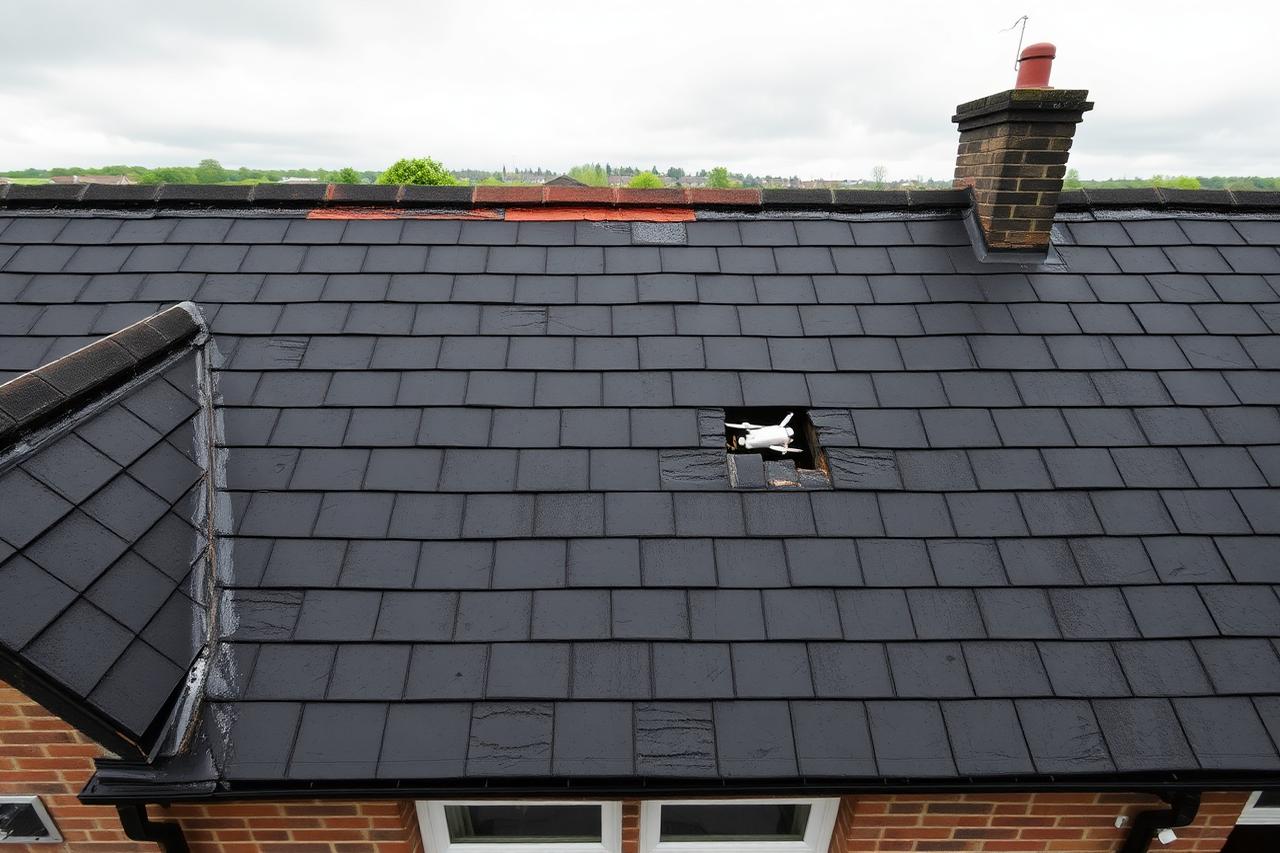 Finding 1Urgent
Front slope, second course below the ridge
What we can see: A group of slates has slipped and two are missing entirely, exposing the batten and felt beneath. The surrounding nail fixings show corrosion, which is typical of nail sickness in a roof of this age.
What it means: Water is reaching the underlay rather than being shed by the slate. Underlay is a second line of defence, not a roof covering, so a leak into the roof space is likely if this is left through a wet winter.
Recommendation: Re-slate the affected area using matching reclaimed slate and copper nails. Check the adjacent courses for further loose fixings while the access is in place.
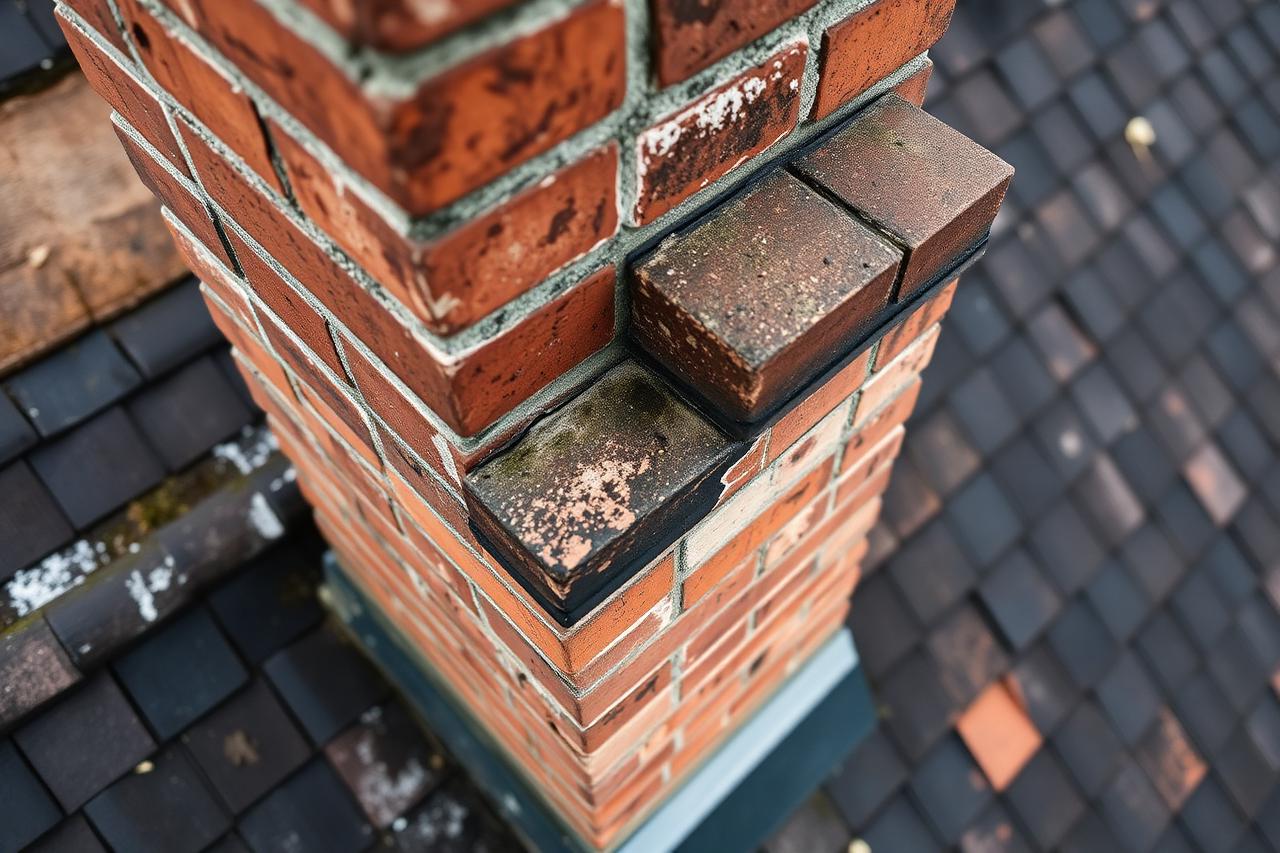 Finding 2Soon
Party wall chimney stack, north-west face
What we can see: Mortar joints in the upper courses are eroded and there is cracked cement mortar where the flashing meets the brickwork. The flaunching around the pot is weathered but intact.
What it means: Cement fillet at an abutment is a common source of damp on chimney breasts. Once it cracks, water tracks down the stack rather than being thrown clear.
Recommendation: Rake out and repoint the affected joints, and replace the cement fillet with correctly dressed and wedged lead flashing. No rebuild is needed at this stage.
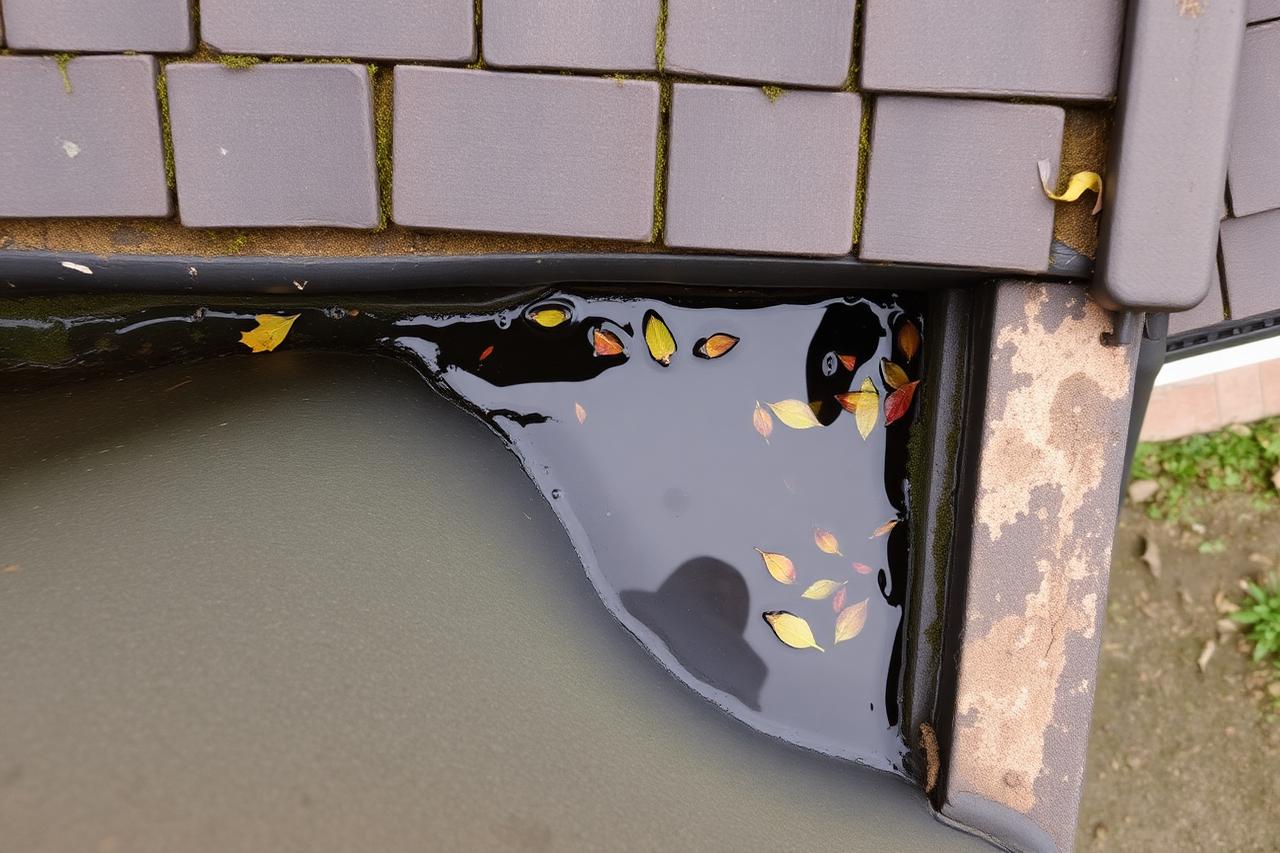 Finding 3Soon
Rear valley and eaves gutter run
What we can see: The gutter is holding standing water, moss and leaf debris along roughly half its length, and debris has built up at the foot of the valley.
What it means: A gutter that cannot clear water will overflow at the back edge, saturating the fascia and the wall head. Blocked valleys back water up under the slate.
Recommendation: Clear and flush the full gutter run and valley, then check the fall and the joint seals. Inspect the fascia behind the gutter for early rot while it is clear.


How priorities are graded
Urgent
Water is getting in, or will do at the next spell of bad weather. Deal with it now.
Soon
Not leaking yet, but deteriorating. Cheaper to correct this year than next.
Monitor
Noted for the record. No action needed yet — recheck at the next survey.
Your options
Insurance evidence survey
Dated imagery of storm or impact damage captured to support a claim, showing the extent and nature of the damage.
Pre-purchase roof survey
A roof condition check before you commit to buying, giving you a factual basis for negotiating or for budgeting future work.
Storm damage assessment
Rapid post-storm survey establishing what has been lost or displaced without anyone climbing a damaged roof.
Preventative maintenance survey
Periodic condition checks so small defects are caught while they are still cheap to correct.
Commercial roof inspection
Survey of large flat, profiled or fragile commercial roofs where access is restricted or expensive.
Residential roof inspection
Standard domestic roof survey covering all slopes, chimneys, valleys and rainwater goods.
Mistakes and shortcuts to avoid
Assuming a drone can see everything
A drone survey shows the external condition of the roof in detail. It does not replace an internal loft inspection, which is where perished underlay and timber decay are seen.
Photographs without interpretation
Images alone are not a survey. The value is in identifying which of the defects visible actually matters and why.
Flying in unsuitable conditions
Strong wind and heavy rain compromise both safety and image quality. A survey should be rescheduled rather than rushed.
Ignoring airspace and privacy rules
Flights must comply with UK Civil Aviation Authority requirements and respect neighbouring properties and people on the ground.
Drone Roof Inspections: common questions
Where we carry out this work
We are based in Carlisle and cover the city, the wider county and across the border into South West Scotland.
Related services
- Roof RepairsA roof repair fixes a localised fault — slipped slates, cracked tiles, failed flashing, a leaking valley or a split flat-roof seam — without replacing the whole roof. Most Cumbrian domestic repairs are completed in a single visit once the true cause of the leak has been identified.
- Emergency Roof RepairsAn emergency roof repair makes a property safe and watertight quickly after storm damage, a sudden leak or falling slates. The first visit stops water entering and removes any danger to people below; the permanent repair follows once the roof is safe to work on.
- Chimney RepairsChimney repairs cover repointing, rebuilding, flaunching, flashing renewal, pot and cowl work and, where a stack is redundant, removal below the roof line. Chimneys are the most exposed masonry on a building and are the single most common source of roof leaks.
- Flat RoofingFlat roofing covers extensions, dormers, garages and small commercial roofs using single-ply EPDM, GRP fibreglass, liquid-applied or hot-melt systems. Modern systems are laid as a continuous waterproof layer with falls designed to clear water to the outlet.
Related guidance
- Understanding Roof EvidenceWhat roofing photographs should show, what they can prove, what they cannot, and how to read the evidence behind any recommendation you are given.
- Choosing a RooferHow to check who is climbing onto your roof, what a written scope should say, and what to be shown before you agree to anything.
- Roof & Drone InspectionsWhat an inspection can document, what a drone can and cannot show, and what you should receive at the end of one.