
Roofing across Carlisle, Cumbria & South West Scotland

07519 261004

Roof Evidence & Repair Guide

Understanding roof evidence

What roofing photographs should show, what they can prove, what they cannot, and how to read the evidence behind any recommendation you are given.

Answers in this topic

What should a photograph of failed roof flashing show?

The short answer

It should show the failure itself — a split, a lifted edge, lead pulled from its chase or a cracked mortar fillet — and enough of the surrounding junction to see where on the roof it sits. A close crop with no context proves very little about the extent of the problem.

What evidence should you look for?

A visible split, gap or lifted edge in the flashing, with the junction around it.

What it can mean
The detail is no longer closing that junction.
What else could explain it
Weathering and discolouration can look like failure in a photograph while the lead is still sound.

Repair soon · Inspection needed to confirm

What this evidence cannot tell you

An image shows that a detail has failed, not how long water has been getting past it or what condition the timber and underlay behind the junction are in. That needs the flashing lifting.

What this looks like on a real roof

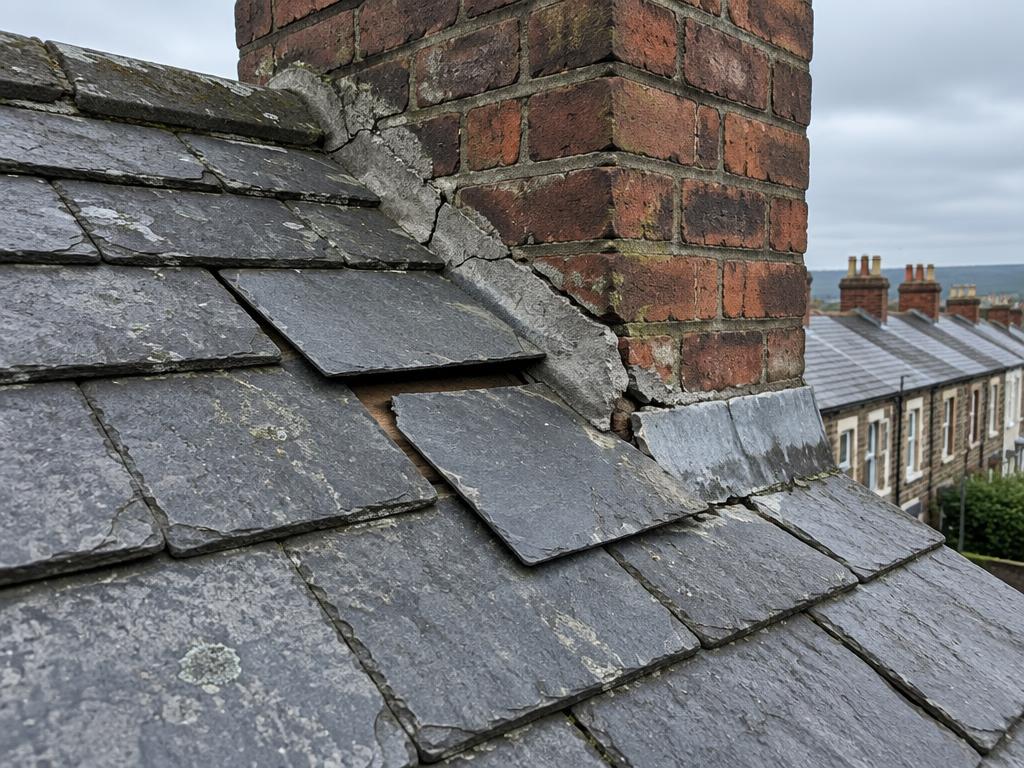
Illustrative example: slipped natural slates beside a brick chimney with a cracked mortar fillet

Illustrative example — not a record of a completed job

Damp patch on a bedroom ceiling close to the chimney breast, appearing only after prolonged wind-driven rain.

Property
Victorian slate-roofed terrace
Area
Typical of older terraced streets in Carlisle
Evidence found
Two slipped slates on the pitch beside the stack, and a mortar fillet around the chimney that had cracked and parted from the brickwork.
How it was inspected
Ground-level observation with a zoom lens, followed by close external inspection of the stack and surrounding slates.
Assessment
The evidence points to water tracking past the chimney abutment and over slates that no longer overlap correctly. It does not establish the condition of the underlay or timbers beneath.
Scope of work
Isolated repair
Outcome
In a case like this the usual course is re-hanging the slipped slates and forming proper lead soakers and stepped flashing, then re-checking the ceiling after the next spell of heavy rain.

Related services

What should you do next?

Ask for one close image and one wider image of the same detail before agreeing to replace a whole flashing run.

What does a slipped slate look like?

The short answer

A slipped slate sits lower than its neighbours, often at a slight angle, sometimes overhanging the course beneath or caught on the gutter. From the ground it shows as a dark, irregular shadow breaking an otherwise even line. The slate itself is frequently undamaged — the fixing has let go.

What evidence should you look for?

One slate out of line and lower than the course around it.

What it can mean
Its fixing has failed or the slate has fractured at the nail hole.
What else could explain it
Reclaimed and hand-made slates are often irregular, so unevenness alone is not always a slip.

Repair soon · Inspection needed to confirm

What this evidence cannot tell you

You can see that a slate has moved; you cannot see from the image why. Whether one nail happened to corrode or the whole roof is at the same stage is only settled by examining recovered nails and neighbouring fixings.

What this looks like on a real roof

Illustrative example: slipped natural slates beside a brick chimney with a cracked mortar fillet

Illustrative example — not a record of a completed job

Damp patch on a bedroom ceiling close to the chimney breast, appearing only after prolonged wind-driven rain.

Property
Victorian slate-roofed terrace
Area
Typical of older terraced streets in Carlisle
Evidence found
Two slipped slates on the pitch beside the stack, and a mortar fillet around the chimney that had cracked and parted from the brickwork.
How it was inspected
Ground-level observation with a zoom lens, followed by close external inspection of the stack and surrounding slates.
Assessment
The evidence points to water tracking past the chimney abutment and over slates that no longer overlap correctly. It does not establish the condition of the underlay or timbers beneath.
Scope of work
Isolated repair
Outcome
In a case like this the usual course is re-hanging the slipped slates and forming proper lead soakers and stepped flashing, then re-checking the ceiling after the next spell of heavy rain.

Related services

What should you do next?

Photograph the whole slope, not just the slate. Whether others have moved is what determines the scale of the work.

What does deteriorated leadwork look like?

The short answer

Look for splits along fold lines, thinning or cracking at stress points, lead pulled out of its mortar chase, edges lifted away from the covering, and repeated mastic patching. A white bloom on the surface is normal oxidation and is not, by itself, a sign of failure.

What evidence should you look for?

Cracks along a fold, or lead visibly lifted from the roof surface.

What it can mean
Thermal movement has exceeded what the detail was designed to take.
What else could explain it
Surface patina and discolouration are normal and unrelated to performance.

Investigate · Inspection needed to confirm

What this evidence cannot tell you

Surface condition is visible; the state of the timber, felt or mortar bed beneath the lead is not. Lead that looks sound can still be leaking at a lap or upstand hidden from view.

Related services

What should you do next?

Ask whether the whole run needs replacing or only the failed section, and ask for the evidence behind that answer.

Should a roofer show me photographs after completing the repair?

The short answer

It is a reasonable thing to ask for and most roofers are glad to provide it. On work you cannot see from the ground, completion photographs are the only practical way to know what was done. Before-and-after images of the same detail, from the same position, are the most useful pairing.

What this evidence cannot tell you

Completion photographs record what the finished work looks like. They cannot demonstrate how the detail was fixed beneath the surface, so they evidence the outcome rather than the whole method.

What should you be shown before agreeing to the work?

  • A before image of the defect
  • An after image of the same detail from the same angle
  • Any additional work carried out while access was available
  • A note of anything found that differed from the quotation

Not every job needs every item. The point is that whatever is recommended should be supported by evidence you can see and a scope you can read.

Related services

What should you do next?

Ask for completion photographs when you accept the quotation, not after the scaffold has gone.

How can I tell whether roofing photographs are actually from my property?

The short answer

Look for recognisable context: your chimney, your neighbour's roof, a satellite dish, the colour and coursing of your own coverings. Ask for a wide shot as well as close crops, and ask for the date the images were taken. Generic close-ups with no surroundings are impossible to place.

What evidence should you look for?

Tight close-ups with no surrounding roof or landmarks visible.

What it can mean
The images cannot be located, whatever their origin.
What else could explain it
Close work often needs tight framing, so this is not evidence of anything improper on its own.

Investigate

What this evidence cannot tell you

Recognisable surroundings confirm where an image was taken, not when. Ask for the capture date, and treat images with no context as unverified rather than as proof of anything about your roof.

Related services

What should you do next?

Ask for one wide image per elevation alongside the close-ups. It resolves the question immediately.

Can roof photographs help when comparing quotations?

The short answer

They help considerably, because they anchor the comparison to the same physical defects. With images in hand you can ask each contractor which of the visible faults their price covers. Differences that looked like pricing often turn out to be differences in scope once the evidence is shared.

What this evidence cannot tell you

Shared images equalise what each contractor has seen from outside. They cannot reveal concealed defects one contractor may have found by lifting coverings, so ask what each did beyond photographing.

Related services

What should you do next?

Send the same images to each contractor and ask each to state which defects their quotation addresses.

Should a roofing quotation identify exactly which roof areas will be repaired?

The short answer

Yes. 'Repair roof' could mean two slates or two square metres. A quotation should name the elevation, the detail and the approximate extent, so both sides know what was agreed. It protects the contractor from scope creep as much as it protects you from underdelivery.

What this evidence cannot tell you

A named area defines what was agreed, not what will be found. Roofs sometimes reveal further defects once opened up, so a quotation should also say how additional findings will be priced.

What should you be shown before agreeing to the work?

  • The elevation and the specific detail being repaired
  • The approximate area or number of units involved
  • What is excluded from the scope
  • How additional work found on site would be priced

Not every job needs every item. The point is that whatever is recommended should be supported by evidence you can see and a scope you can read.

Related services

What should you do next?

Ask for the area to be described so precisely that someone else could find it on the roof.

Can roof underlay fail even when the slates look acceptable?

The short answer

Yes, and it is common on older roofs. Bituminous felt becomes brittle and tears, particularly where sunlight reaches it at the eaves or where it has been repeatedly wetted. The covering above can look perfectly sound while the secondary barrier beneath has effectively stopped working.

What evidence should you look for?

Underlay that tears or crumbles when a covering is lifted.

What it can mean
The secondary barrier is no longer performing.
What else could explain it
Underlay condition varies across a roof; brittleness in one place does not prove failure everywhere.

Investigate · Inspection needed to confirm

What this evidence cannot tell you

Underlay condition cannot be assessed from outside. It is only visible where coverings are lifted or from within the loft.

Related services

What should you do next?

Ask for underlay condition to be recorded wherever a covering is lifted, even on a small repair.

Go deeper on this topic

Related services

Back to the Roof Evidence & Repair Guide

Reviewed by Aaron, Owner, Elite Roofing Services Cumbria Ltd — last reviewed .

Need a roofer in Carlisle or Cumbria?

Tell us what is happening with your roof and send photographs if you have them. We will tell you what we think is wrong and what it will take to put right.

Call nowFree quote