
Roofing across Carlisle, Cumbria & South West Scotland

07519 261004

Roof Evidence & Repair Guide

Roof problems and warning signs

What a failing roof actually looks like from the ground, from the loft and from above — and what each sign can and cannot tell you.

Answers in this topic

Why do roof slates keep slipping?

The short answer

Repeated slipping usually means the fixings rather than the slates are failing. Nails corrode at a similar rate across a roof because they are the same age and share the same exposure, so once a few release, more tend to follow. Battens weakened by damp behave the same way. The pattern matters more than any single slate.

What evidence should you look for?

Several slates slipped over a season, often scattered rather than clustered.

What it can mean
Fixings across that slope are reaching the end of their service life.
What else could explain it
A run of severe weather can displace sound slates on an exposed elevation without systemic failure.

Investigate · Inspection needed to confirm

What could this mean?

Scattered, repeating slips across one slope point to age-related fixing failure. Slips clustered around a chimney, valley or verge usually point to that detail instead.

What this looks like on a real roof

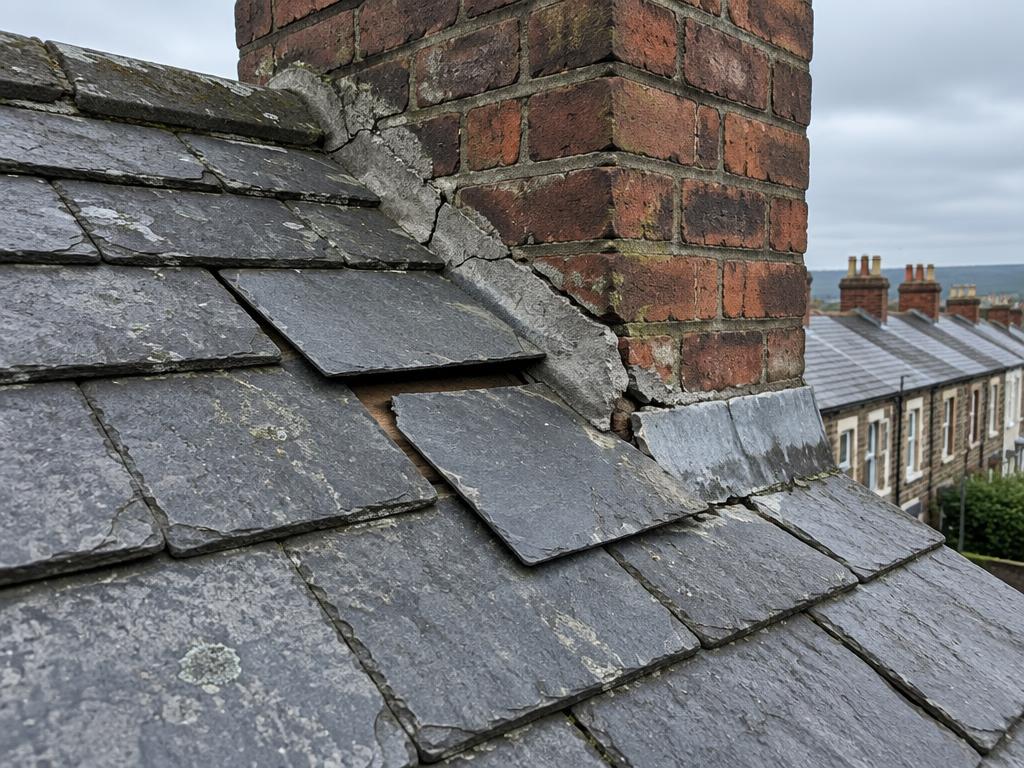
Illustrative example: slipped natural slates beside a brick chimney with a cracked mortar fillet

Illustrative example — not a record of a completed job

Damp patch on a bedroom ceiling close to the chimney breast, appearing only after prolonged wind-driven rain.

Property
Victorian slate-roofed terrace
Area
Typical of older terraced streets in Carlisle
Evidence found
Two slipped slates on the pitch beside the stack, and a mortar fillet around the chimney that had cracked and parted from the brickwork.
How it was inspected
Ground-level observation with a zoom lens, followed by close external inspection of the stack and surrounding slates.
Assessment
The evidence points to water tracking past the chimney abutment and over slates that no longer overlap correctly. It does not establish the condition of the underlay or timbers beneath.
Scope of work
Isolated repair
Outcome
In a case like this the usual course is re-hanging the slipped slates and forming proper lead soakers and stepped flashing, then re-checking the ceiling after the next spell of heavy rain.

Related services

What should you do next?

Ask for the condition of the recovered nails and battens to be recorded, not just the slates. That evidence is what separates a patch repair from a wider discussion.

Why are pieces of slate or tile appearing in my gutter?

The short answer

Fragments in the gutter mean material is breaking away above. On slate it is often delamination or fractures around old nail holes; on concrete tiles it is surface erosion; gritty grey sediment is usually mortar breaking down at the ridge or verge. Any of them is a reason to check the source before the gutters block.

What evidence should you look for?

Flakes, corners of slate or sandy sediment collecting in gutters and downpipe bends.

What it can mean
Coverings or bedding above are weathering and shedding material.
What else could explain it
Debris can be washed down from a chimney, a neighbouring roof, or left behind by recent work.

Investigate · Inspection needed to confirm

Related services

What should you do next?

Keep a sample. Whether it is slate, tile or mortar points straight at which part of the roof is deteriorating.

Is moss on my roof a problem?

The short answer

Moss is very common on north-facing and shaded Cumbrian roofs and is not automatically damaging. It becomes a problem when it holds moisture against coverings through freeze-thaw cycles, blocks gutters as it sheds, or grows thick enough to interrupt drainage between laps. Aggressive removal can cause more harm than the moss itself.

What evidence should you look for?

Thick growth bridging the laps, or moss shedding into gutters.

What it can mean
Water is being held on the surface instead of running off, and drainage is being obstructed.
What else could explain it
A thin surface film on a shaded slope is largely cosmetic and common on sound roofs.

Monitor

What this evidence cannot tell you

Moss cover hides the surface underneath, so a heavily covered roof cannot be condition-assessed accurately until it is cleared.

Related services

What should you do next?

Avoid pressure washing — it drives water under laps and erodes coverings. Ask for careful removal and for the roof to be reassessed once the surface is visible.

Go deeper on this topic

Related services

Back to the Roof Evidence & Repair Guide

Reviewed by Aaron, Owner, Elite Roofing Services Cumbria Ltd — last reviewed .

Need a roofer in Carlisle or Cumbria?

Tell us what is happening with your roof and send photographs if you have them. We will tell you what we think is wrong and what it will take to put right.

Call nowFree quote