
Roofing across Carlisle, Cumbria & South West Scotland

07519 261004

Roof Evidence & Repair Guide

Roof leaks and damp

Tracing water back to where it actually gets in, separating roof leaks from condensation and rainwater goods, and confirming the cause before paying for a repair.

Answers in this topic

Why is my roof leaking?

The short answer

Most leaks start at a junction rather than in the open field of the roof: flashings at chimneys and abutments, valleys, verges, and around vents or rooflights. Displaced coverings and failed underlay account for much of the rest. Water then travels along battens and rafters, so the stain indoors is rarely below the entry point.

What evidence should you look for?

Staining or wet timber in the loft, usually higher up the slope than the ceiling mark.

What it can mean
Water is entering above and running down before it drops.
What else could explain it
Condensation forming on cold timbers and underlay produces similar damp without any breach.

Repair soon · Inspection needed to confirm

Cracked, lifted or patched-up lead at a chimney or abutment.

What it can mean
The flashing is no longer closing the junction.
What else could explain it
Mortar fillets and mastic repairs can look failed while still functioning, or hide a defect behind them.

Repair soon · Inspection needed to confirm

What could this mean?

Weather pattern narrows it usefully. Leaks in heavy vertical rain suggest a volume or drainage problem; leaks in wind-driven rain suggest a lap or flashing detail; leaks that appear after snow lies suggest melt backing up under coverings.

What else could explain it?

  • Overflowing or split gutters wetting the wall head, which can look exactly like a roof leak inside.
  • Plumbing, tank overflow or a leaking heating pipe in the loft.
  • Wall penetration through render cracks or a failed window head.

What this evidence cannot tell you

A single stain seldom identifies its own cause. Linking symptom to entry point usually needs loft inspection during or shortly after rain, plus a look at the external detail above.

How serious is it? — Repair soon

Active water entry damages insulation, plaster and timber progressively, so delay generally increases the scope.

What are the realistic options?

  • Isolated repair

    One identified defect at one detail, with sound coverings around it.

  • Further investigation

    Intermittent damp with no clear external cause, or several possible entry points above the stain.

A wider scope should be justified by what the evidence shows, not assumed.

What this looks like on a real roof

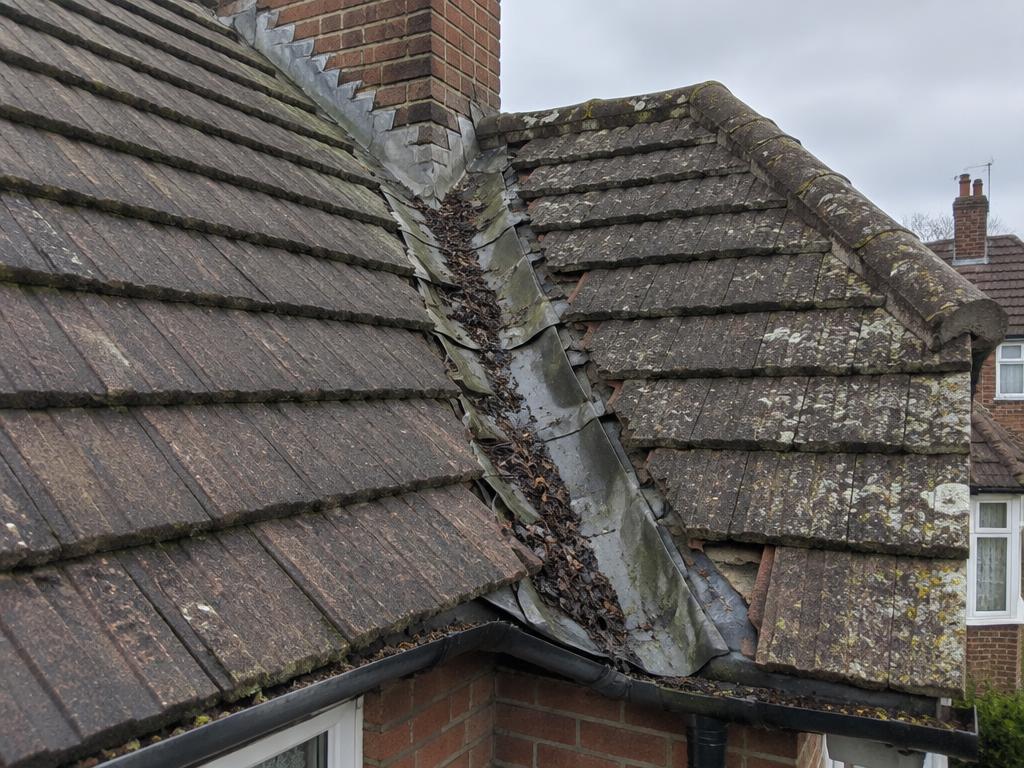
Illustrative example: blocked roof valley with debris and a distorted lead valley lining between two tiled pitches

Illustrative example — not a record of a completed job

Brown staining spreading on a landing ceiling, worse during heavy rather than light rain.

Property
1930s semi-detached house with a tiled roof
Area
Typical of inter-war housing across Cumbria
Evidence found
Leaf and moss debris packed into the roof valley, with the lead valley lining distorted and tiles at the valley edge broken.
How it was inspected
External inspection of the valley, plus observation from inside the loft during and after rainfall.
Assessment
A blocked, damaged valley is a common explanation for staining of this kind, because water backs up and runs sideways under the tiles. Internal staining alone does not confirm the entry point.
Scope of work
Further investigation
Outcome
Clearing and re-forming the valley is the usual first step, with the ceiling monitored afterwards to confirm the water path has actually been closed.

Related services

What should you do next?

Note the weather each time it leaks, and photograph the loft directly above the stain while it is wet. That pairing is the most useful evidence anyone can bring to an inspection.

Read the full guide on this

Can failed lead flashing cause a roof leak?

The short answer

Yes, and it is one of the most common causes. Lead moves with temperature, and over-long or poorly fixed sheets crack at the fold. Mortar chases fail, and mastic repairs shrink and pull away. Once the flashing no longer closes the junction, water passes behind the covering and appears some distance away inside.

What evidence should you look for?

Splits along a fold line, lead lifted from its chase, or repeated mastic repairs.

What it can mean
The detail has failed and water is passing behind it.
What else could explain it
Lead can look weathered and discoloured while remaining perfectly sound.

Repair soon · Inspection needed to confirm

What this looks like on a real roof

Illustrative example: blocked roof valley with debris and a distorted lead valley lining between two tiled pitches

Illustrative example — not a record of a completed job

Brown staining spreading on a landing ceiling, worse during heavy rather than light rain.

Property
1930s semi-detached house with a tiled roof
Area
Typical of inter-war housing across Cumbria
Evidence found
Leaf and moss debris packed into the roof valley, with the lead valley lining distorted and tiles at the valley edge broken.
How it was inspected
External inspection of the valley, plus observation from inside the loft during and after rainfall.
Assessment
A blocked, damaged valley is a common explanation for staining of this kind, because water backs up and runs sideways under the tiles. Internal staining alone does not confirm the entry point.
Scope of work
Further investigation
Outcome
Clearing and re-forming the valley is the usual first step, with the ceiling monitored afterwards to confirm the water path has actually been closed.

Related services

What should you do next?

Ask to see a photograph of the actual crack or lifted edge before agreeing to replace an entire flashing run.

Can a roof leak damage rafters and roof timbers?

The short answer

It can, given time. Timber tolerates occasional wetting if it dries out between times. Repeated wetting that never dries — typically where insulation holds water against a rafter — leads to decay, and in the worst cases to fungal attack that spreads beyond the wet area. Early repair usually keeps this to nothing.

What evidence should you look for?

Darkened, soft or crumbling timber, or insulation that is compressed and damp.

What it can mean
Water has been present long enough to affect the timber itself.
What else could explain it
Old staining from a repaired leak can look alarming while the timber is dry and sound.

Investigate · Inspection needed to confirm

What this evidence cannot tell you

Surface appearance does not establish the extent of decay; probing and, in significant cases, a structural opinion are needed.

Related services

What should you do next?

Press suspect timber gently with a screwdriver tip. Sound timber resists; decayed timber gives. Report what you find rather than guessing at the extent.

Go deeper on this topic

Related services

Back to the Roof Evidence & Repair Guide

Reviewed by Aaron, Owner, Elite Roofing Services Cumbria Ltd — last reviewed .

Need a roofer in Carlisle or Cumbria?

Tell us what is happening with your roof and send photographs if you have them. We will tell you what we think is wrong and what it will take to put right.

Call nowFree quote